CBT Therapy in Sydney
Looking for CBT therapy in Sydney? Insight Psychology offers Cognitive Behavioural Therapy in Newtown with Dr John Ahern, supporting adults with anxiety, panic, OCD, depression, trauma, stress and burnout. CBT is structured, practical and evidence-based, with sessions focused on understanding what keeps difficulties going and building strategies you can use outside the therapy room.
CBT looks at what is happening now — situations, thoughts, emotions, body sensations and behaviours — and how they connect. It's collaborative work: together we map the cycle keeping a problem in place and identify where change is possible.
CBT with Dr John Ahern
Dr John Ahern is the founder of Insight Psychology and provides CBT-informed therapy in Newtown, Sydney. His style is warm, practical, collaborative and evidence-based. CBT may be used on its own or, where clinically appropriate, alongside other approaches such as EMDR, ACT, DBT and Schema Therapy.
What Is CBT Therapy?
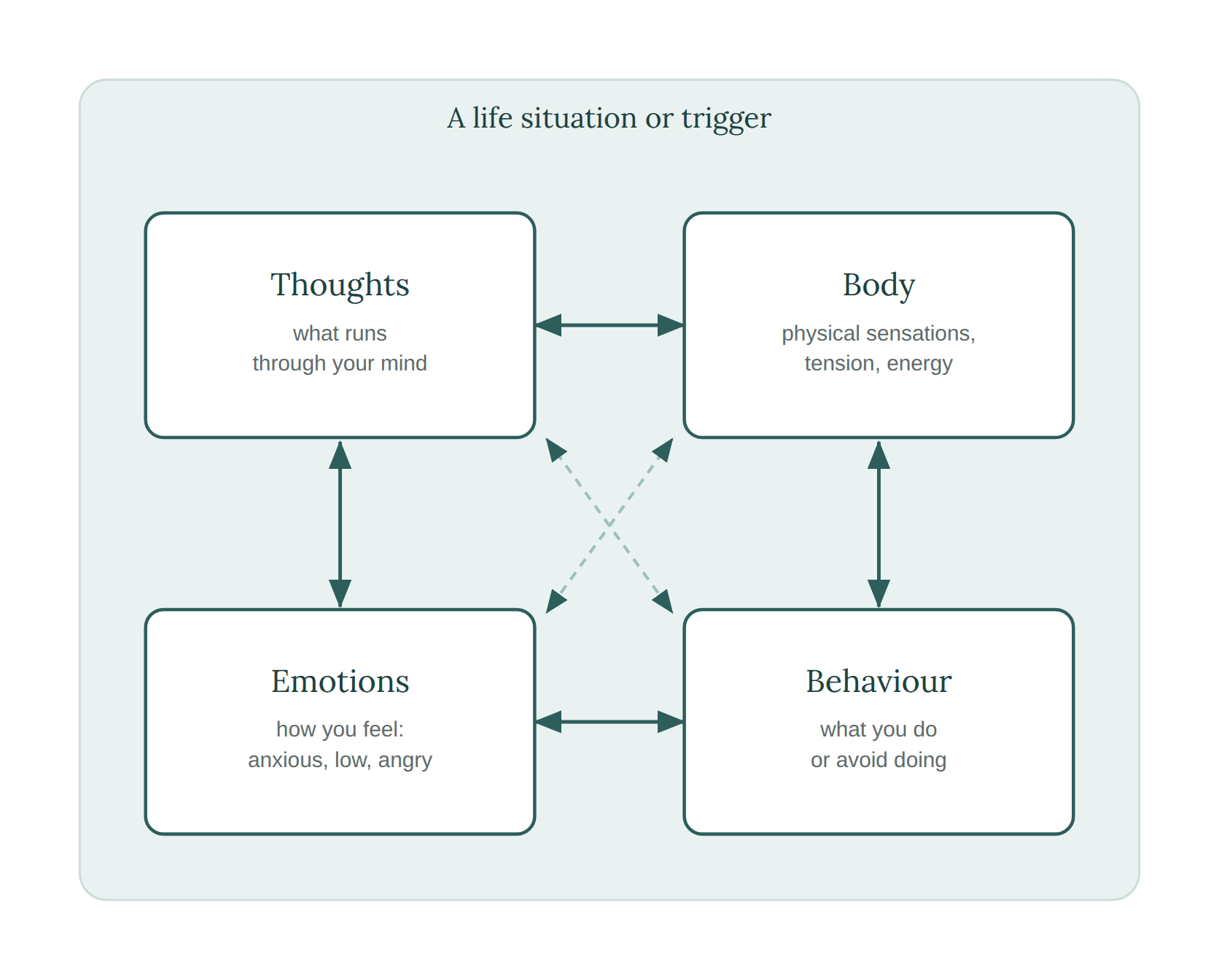
Cognitive Behavioural Therapy (CBT) is a structured, evidence-based talking therapy. It is present-focused and practical, looking at situations, thoughts, emotions, physical sensations and behaviours — and how these parts influence one another. Therapy works by identifying where change may be possible.
How Does CBT Work?
CBT is built on the idea that thoughts, emotions, body sensations and behaviours are connected. When one shifts, it can influence the others. That can work against us when a cycle becomes stuck — but it also makes change possible, because there are several points where therapy can help.
How the Four Parts Connect
What a Course of CBT Looks Like
CBT is usually delivered in four broad phases, tailored to you. Not everyone needs every step, and we revisit earlier phases whenever it helps.
Understand
Mapping your cycle, understanding how the difficulty is kept going, and setting goals together.
Test thoughts
Learning to notice unhelpful thoughts, spot thinking traps, and test thoughts against the evidence.
Change behaviour
Graded exposure, behavioural experiments, behavioural activation, and skills such as breathing and relaxation.
Stay well
Consolidating gains, problem-solving, and building a relapse-prevention plan so change lasts.
CBT is not one technique but a toolkit, used in a sensible order and tailored to you:
What CBT Can Help With
Many common difficulties are kept going by a loop where our response to distress accidentally feeds the very thing we're trying to escape. CBT helps because once the loop is visible, there may be ways to interrupt it. CBT may support:
CBT for Anxiety, Panic and Phobias
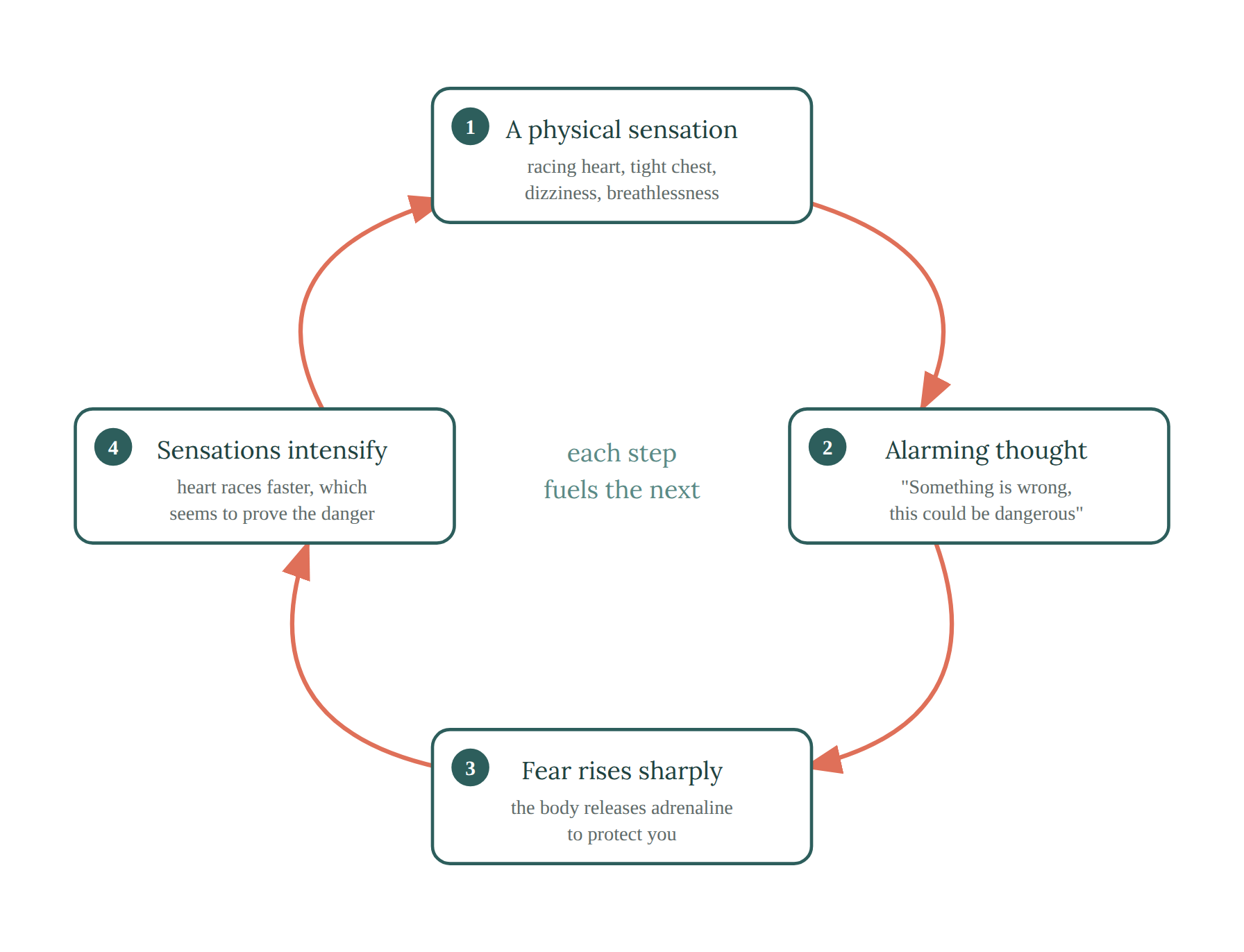
A panic attack often begins with a normal physical sensation that gets read as a sign of danger. The fear produces more of the same sensations, which seems to confirm the danger, and the cycle accelerates. CBT helps you recognise the sensations as not dangerous, slow the cycle down, and gradually test the feared prediction until panic loses its grip.
CBT for Social Anxiety
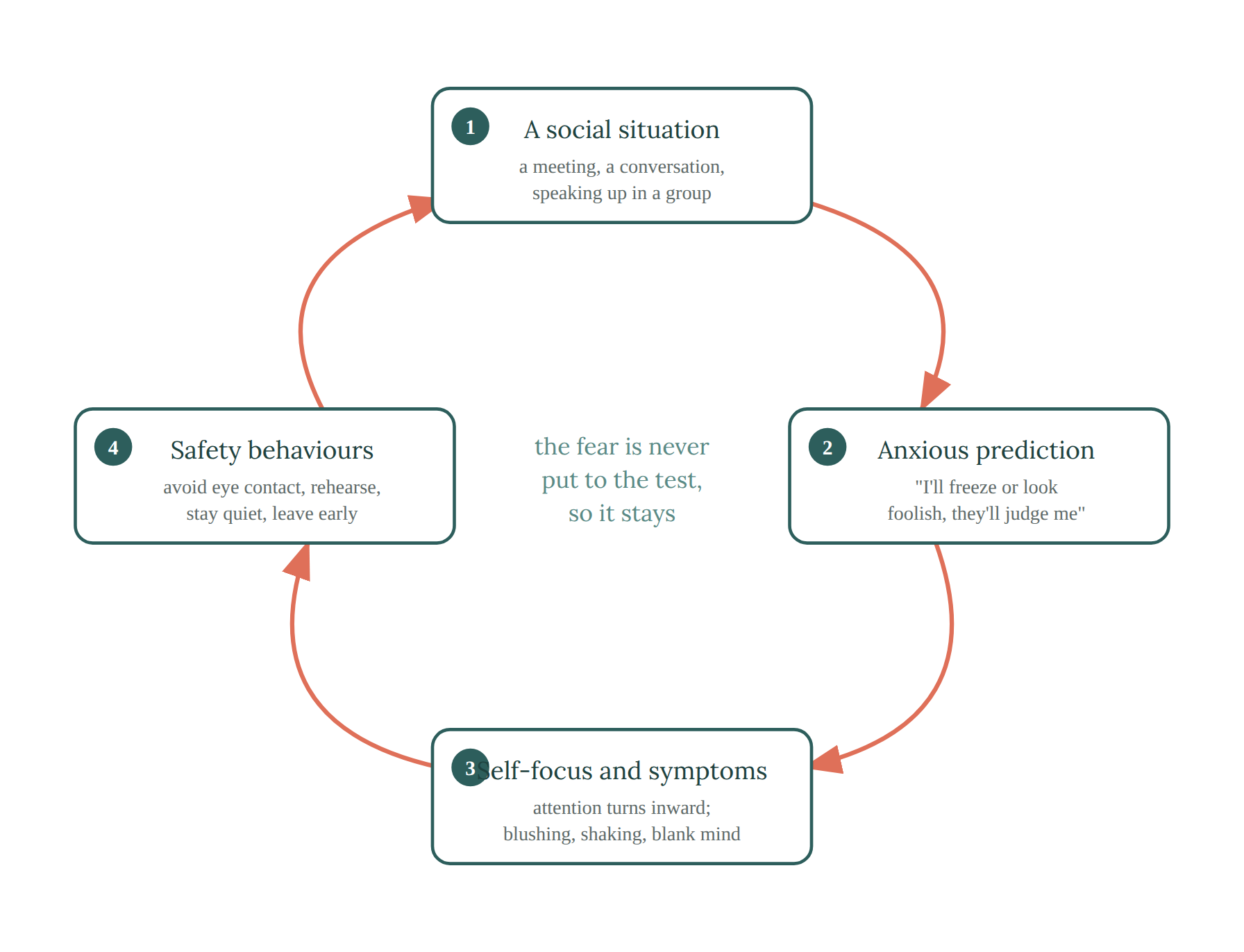
Social anxiety often involves a fear of judgement, embarrassment or rejection. Safety behaviours such as avoiding eye contact, over-preparing or staying quiet may reduce anxiety briefly, but they stop the feared outcome from being properly tested. CBT helps you gently reduce safety behaviours and shift attention outward, so real experience can replace the feared prediction.
CBT for OCD
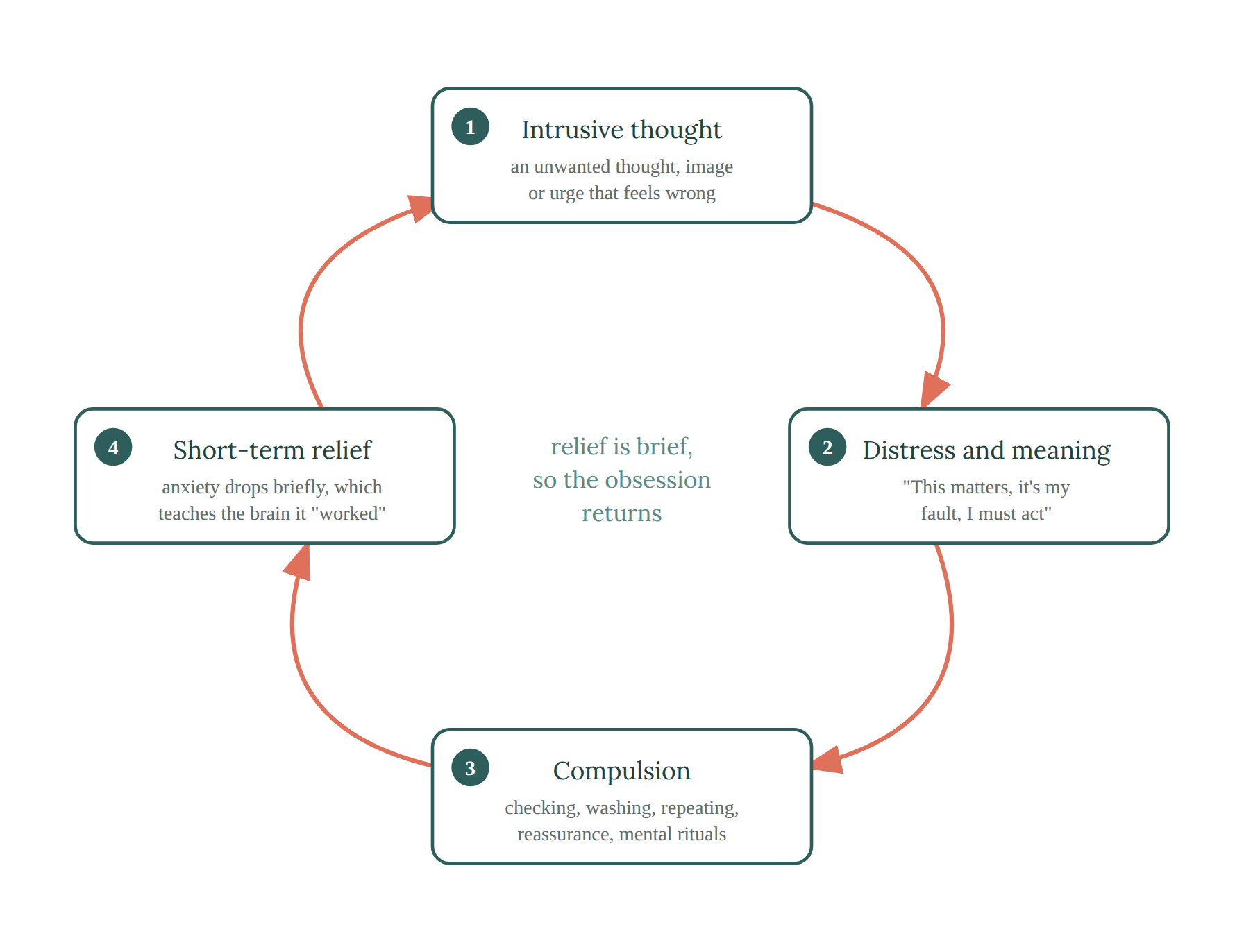
In OCD, an unwanted thought is treated as meaningful and threatening. A compulsion brings short-term relief, which trains the brain to rely on it, and because the relief does not last, the obsession keeps returning. CBT for OCD often includes Exposure and Response Prevention (ERP): facing triggers while resisting compulsions, so the brain learns the feared outcome does not arrive, or that uncertainty can be tolerated.
CBT for Depression, Trauma and Other Presentations
Depression
When low mood takes hold it tends to shrink activity and feed negative beliefs about the self, world and future. CBT may use behavioural activation to rebuild momentum and cognitive work to loosen the grip of those beliefs.
Trauma & PTSD
Trauma-focused CBT can be used for PTSD. For some people, particularly with single-incident or complex trauma, EMDR may be considered alongside or instead of CBT where clinically appropriate. EMDR therapy in Sydney →
Other Presentations
- Health anxiety
- Stress, burnout & adjustment difficulties
- Anger & emotion regulation
- Sleep difficulties
- Low self-esteem & negative core beliefs
Research and Evidence Base for CBT
CBT is one of the most thoroughly researched psychotherapies available (sources under References).
- 1First-line status: Australian and international clinical guidelines recommend CBT as a first-line treatment for depression and many anxiety disorders.
- 2Breadth of evidence: CBT has been tested in many randomised controlled trials and meta-analyses across anxiety, depression, panic, social anxiety and OCD.
- 3Transferable skills: CBT teaches practical skills that people can keep using after therapy ends.
- 4Local expertise: Dr John Ahern's doctoral research focused on complex trauma and clinician perspectives on Complex PTSD, informing how trauma-related material is understood in practice.
Frequently Asked Questions
Is CBT evidence-based?
Yes. CBT is recommended as a first-line treatment for many anxiety disorders, depression and OCD in Australian and international clinical guidelines, and is one of the most extensively researched psychotherapies.
Is CBT just positive thinking?
No. CBT is not about forcing yourself to think positively. It is about checking whether a thought is accurate and helpful, then testing it against real experience. Sometimes a worry turns out to be realistic, and then the focus becomes how to respond to it well.
How many CBT sessions will I need?
This varies depending on what you are working on. CBT is usually focused and goal-directed, and your psychologist will discuss an individual plan with you at assessment and review progress regularly. CBT often works best when skills are practised between sessions, with tasks tailored to your situation.
Will I have to talk about my childhood?
CBT is mainly present-focused. Your history may be discussed where it helps make sense of current patterns, but you will not be expected to relive the past in detail unless it is useful for you.
Does CBT work for more than anxiety and depression?
Yes. CBT is also used for panic, social anxiety, OCD, phobias, health anxiety, PTSD, stress and other difficulties where unhelpful patterns of thinking and behaviour are keeping a problem going.
Can CBT be done via telehealth?
Yes. CBT can work well over secure video. At Insight Psychology, both in-person appointments in Newtown, Sydney and telehealth appointments are available where appropriate.
What qualifications should a CBT therapist have?
In Australia, CBT should be delivered by a registered psychologist or appropriately trained mental health clinician. Dr John Ahern is a registered psychologist with AHPRA, holds a PhD in Clinical Psychology, and works across anxiety, mood, trauma and complex presentations.
Do I need a referral, and can I claim Medicare?
You can book privately without a referral. If your GP prepares a Mental Health Treatment Plan, you may be able to claim a Medicare rebate for eligible sessions. The rebate does not usually cover the full fee, and a gap may apply. Confirm current details before booking.
Recommended Reading
Guides to help you understand CBT. New articles are being added over time.
What Is CBT and How Does It Work?
A plain-English explainer of CBT and the four-part model.
CBT vs EMDR: Which Therapy Is Right for You?
How the two approaches differ and when each may suit.
What to Expect in Your First CBT Session
How the first session is structured and what you'll cover.
Downloadable Resources
Practical CBT tools to support your sessions.
Thought Record Worksheet
Notice a thought, weigh the evidence, and find a more balanced view.
Understanding CBT: A Guide for New Clients
What to expect from CBT and how to get the most from it.
Building an Exposure Ladder
Break a feared situation into small, manageable steps.
Slow Breathing for Panic
A short breathing technique to help settle the body.
Book CBT Therapy in Sydney
Located in Newtown, Sydney. In-person and telehealth appointments available. Medicare rebates may apply with a valid Mental Health Treatment Plan.
Email: insight-psychology@outlook.com | Phone: 0410 009 554
Choose an available time
Open booking pageFind the clinic
6/134–140 King Street, Newtown, NSW 2042 · Telehealth available Australia-wide
References
- Australian clinical guideline / professional source for CBT
- NICE (or equivalent) clinical guideline for CBT
- Peer-reviewed review or meta-analysis on CBT outcomes
This page is general information only and is not a substitute for personalised psychological advice, diagnosis or treatment. CBT may not be the right approach for everyone. A psychologist can assess your history, current symptoms, goals and support needs before recommending a treatment plan.
Insight Psychology is not a crisis service. If you are in immediate danger, call 000. If you need urgent mental health support in Australia, contact Lifeline on 13 11 14 or Beyond Blue on 1300 22 4636.